
Saturday, January 29, 2022

Like the Cool Kids


“There are writers’ cliques in horror, and if you don’t belong to one, you can’t get published. And not only don’t they support new writers, they actively work to keep us out!”

I’ll be fifty-eight soon. I started writing and submitting fiction to publishers when I was eighteen, which means I’m coming up on my fortieth anniversary as a writer. I can’t tell you how many times during my career I’ve heard statements like the one above, and not just regarding horror but other genres too. The people making these statements believe there’s a nebulous group of professional writers who are friends and who won’t allow anyone into their closed circle. They exclusively publish each other’s stories in magazines and anthologies, and they sing the praises of each other’s work and no one else’s. Somehow, they act as gatekeepers for their entire genre, making sure that no new writers can rise to their level in publishing and become a threat to their power and prestige.

Are there writers’ cliques? I suppose it depends on what you consider a clique. There are groups of writers who’ve become friends over the years, maybe because they all started writing at the same time and have a shared history in the publishing industry. Or maybe they’re friends because they met each other and hung out at various conventions over the years. Or maybe they’re fans of each other’s work and became connected that way. Often, it’s a combination of all these things. And yes, if any of the writers edit a magazine or anthology, they’re more likely to invite their friends to submit because they know the quality of their writing and that they’ll be easy to work with. But do these groups really act as genre gatekeepers, repelling any new writers who dare to challenge their supremacy?

Not that I’ve seen in the last four decades.

“Sure you’d say that, Tim,” you might be thinking. “You’ve been writing and publishing for a long time now. You are one of the cool kids.”

Allow me to laugh my ass off for a few minutes before I go on.

. . .

Okay, I’m back <wipes away tears of hilarity>.

I’ve never felt like an insider of any kind during my life, and while I’m friends with a lot of writers, these friendships in and of themselves haven’t furthered my career. I’ve gotten encouragement, advice, and support from these friendships – I mean, isn’t that what friends do for each other? – and sure, there’s a certain amount of networking that goes on, but it’s not as if any of us know The Big Secret to having insanely massive success as a writer. If we did, we’d take advantage of this secret ourselves and be swimming in cash like Unca Scrooge in his money bin. Whatever success I’ve achieved in my career has come two ways: 1) Writing regularly and constantly striving to become better at my craft and 2) Persisting in the face of rejections, self-doubt, poor reviews, and career setbacks. So when I get invited to submit to an anthology or when a friend tells me about a writing opportunity that’s not common knowledge, it’s because I’m a skilled writer with a long track record of publication. I’ve taught college writing classes for almost as long as I’ve been writing, and I’ve liked the vast majority of students that I’ve had over the years. But the ones I’ve recommended for various writing opportunities have been the ones with the most skill, not the ones I liked the most.

In my experience, there’s no such thing as all-powerful cabals of writers who work to keep newer writers from rising to their exalted level. So why do newer writers continue to believe in such cabals, and why do rumors about their existence pop up again and again throughout the years? I don’t know for certain, but you likely won’t be surprised to learn I have a few theories.

1)      A need for control. So much of a writer’s career when it comes to publishing is beyond our control. It’s difficult to believe that luck plays a gigantic role in which writers go on to big careers. We can’t control luck (although we can prepare ourselves to take advantage of whatever luck comes our way). And we sure don’t want to believe that our writing, while (hopefully) good, isn’t good enough for us to climb the ladder of success much farther than where we’re at currently. It’s far easier to blame someone, anyone, for our lack of major success. Blaming people gives us something specific to focus on rather than something abstract, like luck, and if some cabal of writers is out to get us, it’s because we must be a threat to them, which means we must be as good a writer as they are, if not better. Not only is the fantasy of the sinister writing cabal more emotionally satisfying, it allows us to control the narrative of our career, giving us a villain to counter the hero we so desperately want to see ourselves as.

2)      Envy. We often admire those writers we see in our imaginary cabal, and we wish we could be part of their circle. We want them to recognize us as an equal and anoint us a True Writer, worthy of being one of the cool kids. If we believe there’s an inside, it hurts to think we’re on the outside and may always be.

3)      Social media. We see writers post successes on social media all the time, and often these successes demonstrate that these writers are leveling up in their careers. Major book contracts. Critical acclaim. Award wins. Film adaptations. It’s only natural for us to wonder when we’ll get these things, and we fear that we may never get them. It can begin to seem that every writer aside from us is having fantastic success all the time, but this is an illusion. We pay more attention to these announcements than when someone posts that they managed to write 500 words today. Writers with major success are few and far between compared to all the writers chugging away, writing and hoping, day after day.

4)      Belief that relationships in the writing community should be transactional. We supported a writer when they were starting out, engaged with them on social media, commented on their posts, retweeted announcements about their book releases . . . and when they start to have success, they don’t reach down and lift us up to their level. We can become angry, even bitter. We say they’ve forgotten where they came from, that they’ve turned their back on the people who helped them when they were coming up.

5)      Career expectations warped by society’s view of success. American culture says you’re not a true success unless you become mega famous and mega rich (and it doesn’t hurt to be mega beautiful, either). If society has been ramming this definition of success down your throat all your life, you end up believing it, even if you don’t realize it. So whatever success we do achieve is like cold, bitter ashes in our mouth. Because it’s not – and can never be – enough.

6)      We overestimate our writing ability. A lot of us fear that we’re not good enough writers, but many of us believe we are fucking AWESOME! Not only that, but our writing is so much better than the shit more successful writers crap out. How can they be such big hits when we’re not? We come to believe that something is seriously wrong with publishing when such a profound injustice can occur. The only way someone as talented as us isn’t successful yet has to be because someone is purposefully keeping us down.

So if there aren’t any sinister cabals preventing your success, and belonging to a clique won’t help your career in any appreciable way, how can you, all by your lonesome, do the things that these mythical cabals are said to do?

1)      Continue improving as a writer. Whatever success we get in the publishing world comes from the quality of our work. Sometimes that means literary excellence,  sometimes it means our work is entertaining, sometimes it means our work fits the needs of the current market, and sometimes it’s all three. But the quality of our work is the only thing that we can really control, and while we may not all have the capability of becoming Pulitzer Prize winners, we can all improve.

2)      Find a niche that works for you. One of the reasons writers achieve success is that they’re recognized as producing a certain kind of work: literary horror, humorous romance, fast-paced thrillers . . . If you can find a specialty that works for you – one you enjoy and that readers respond to – you’re more likely to find some measure of success, even if you never become a bestseller. And don’t just write typical genre fare. Write the stories only you can tell. Look at the most successful authors in your field. None of them are the same. They have their own voices, visions, and themes. You should too.

3)      Try writing something different. On the other hand, maybe you already have a specialty and your career isn’t going anywhere. Maybe you should experiment a bit, try writing some other stuff, and see if maybe a different genre/niche might work better for you career-wise. For example, John Jakes started out writing science fiction before becoming a bestseller writing historical fiction. Lawrence Block wrote soft-core erotica as a young author before turning to mystery fiction. Maybe you just need a change.

4)      Make connections with people for the right reasons. When I first started going to conventions, I read articles and books on networking and tried to employ the techniques I learned. I felt awkward, and more importantly, I felt like I was trying to cynically use people to further my own career. I said fuck it, I’m just going to be myself and if I make connections with people, it’ll be because I like them and they like me, not because I read some goddamn business book filled with networking techniques. I don’t try to force connections, and I don’t expect those connections to lead to anything other than my getting to know some great people. If those connections end up benefitting my career, it's a nice bonus.

5)      Support others without expecting any support in return. I regularly like, comment, and share other authors’ social media posts, but I don’t expect them to do anything for me in return. If they do, I appreciate it, but my support doesn’t come with a price. If writers email me asking for advice, I give it without considering how they’ll repay me. Expecting one-to-one reciprocity for your support and not getting it will only lead to anger and resentment on your part. Understand this: No one owes you anything for your support. Your support should be freely given without any expectation of reward. If it isn’t, it’s not truly support. It’s merely you trying to use others for career advancement.

6)      Understand that other writers can’t work miracles for you. Sometimes when I hear a new writer wonder why more successful writers don’t help them, I think, “What the hell do you think we can do for you?” We can’t work magic and transform you into a wildly successful author. We can recommend you to agents and editors, but we can’t make them take you on. I’ve recommended a number of writers over the years – some of them well-published professionals – and very few of those recommendations have paid off for them. I’ve taught probably thousands of students over the years, and only a small percentage of them have gone on to any kind of writing career. Plus, we can’t help everyone who wants our help. If we tried, we’d never have time to write anything of our own. I help newer writers by teaching classes and workshops, as well as mentoring writers through the Horror Writers Association’s mentoring program. I also write this blog, put publishing and writing tips in my newsletter, and record videos about writing and publishing for my YouTube channel. And I’ve written two books on writing horror: Writing in the Dark and The Writing in the Dark Workbook (which is forthcoming). Sure, these things promote my work, but they also allow me to give advice to many writers at once. I do what I can, where I can, how I can, and I choose how much or how little of it to do at any given time for my health and my sanity.

7)      Forget society’s definition of success. If you buy into the American myth that mega success is the only real success, you’ll always believe yourself to be a failure, no matter how much writing success you have.

8)      Have realistic expectations about a writing career. Recently, Laird Barron posted on Twitter that “Every day, art Twitter expresses shock and amazement that most artists live and die in obscurity.” This is the painful truth of living a life in the arts, and you need to make your peace with it. Very few people on Earth read for pleasure, and many of them probably don’t enjoy the kind of fiction you prefer to write. Even the biggest flop of a movie has millions of more viewers than your fiction will have readers (maybe in your entire career). Learn that it’s okay to have a small audience that gets your stuff and enjoys it. Learn to appreciate the experiences you gain from a life in writing. Realize that writers you consider masters today will be forgotten soon after they die – just as most of us likely will. Try not to let this get you down. Appreciate the moments as you live them, write for today, enjoy your life and career, and let tomorrow take care of itself.

9)      Make peace with not having much control. You can rage about not having control or you can accept it, but you will never get control over every aspect of your writing career. If you accept this, your life will be a hell of a lot easier and more enjoyable.

10)  Understand it’s all a crapshoot in the end. There is nothing you can purposefully do to ensure that you have mega success as a writer. NOTHING. No one is trying to keep you from succeeding. The odds of any big success in the arts are so slim as to be almost nonexistent. That doesn’t mean your shouldn’t try to take your career as far as you can in the time you have – you should! But your primariy concern should be producing good work and sharing it with the world (even if it’s an extremely small percentage of the world). Your life won’t be worth more if you’re one of the few lucky ones and achieve mega success, and it won’t be worth less if your success is minimal. Be ready to take advantage if and when luck comes your way, but in the meantime, just keep writing. And for fuck’s sake, try to enjoy the journey.

DEPARTMENT OF SHAMELESS SELF-PROMOTION

Planet Havoc: A Zombicide Novel
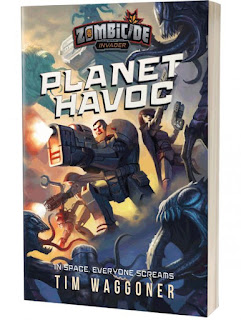


Advance reviews of Planet Havoc have been good, and Jonathan Maberry was kind enough to read an advanced copy and provide a blurb!

“PLANET HAVOC is the best of all worlds –space adventure, military SF, snarky humor, and zombies! Tim Waggoner brings the pain and all the jolts in this rollicking action horror thriller!” – Jonathan Maberry, NY Times bestselling author of the Joe Ledger thrillers and KAGEN THE DAMNED

Planet Havoc is due out in April and is available for preorder.

Scoundrels and soldiers band together to survive the onslaught of alien-zombies spreading across the galaxy in this riotous adventure from the bestselling game, Zombicide: Invader

A deserted R&D facility tempts the hungry new Guild, Leviathan, into sending a team to plunder its valuable research. The base was abandoned after a neighboring planet was devastated by an outbreak of Xenos – alien zombies – but that was a whole planet away... When the Guild ship is attacked by a quarantine patrol, both ships crash onto the deserted world. Only it isn’t as deserted as they hope: a murderous new Xeno threat awakens, desperate to escape the planet. Can the crews cooperate to destroy this new foe? Or will they be forced to sacrifice their ships and lives to protect the galaxy?

Amazon Paperback

https://www.amazon.com/Planet-Havoc-Zombicide-Invader-Novel/dp/1839081244/ref=tmm_pap_swatch_0?_encoding=UTF8&qid=1635525512&sr=1-3

Kindle

https://www.amazon.com/Planet-Havoc-Zombicide-Invader-Novel-ebook/dp/B09FKJ98R8/ref=sr_1_3?dchild=1&keywords=tim+waggoner&qid=1635525512&s=books&sr=1-3

Barnes & Noble Paperback

https://www.barnesandnoble.com/w/planet-havoc-tim-waggoner/1140135739?ean=9781839081248

NOOK Book

https://www.barnesandnoble.com/w/planet-havoc-tim-waggoner/1140135739?ean=9781839081255


We Will Rise
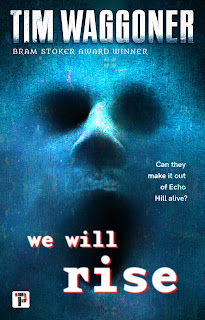


My next horror novel is due out this July from Flame Tree Press!

In Echo Hill, Ohio, the dead begin to reappear, manifesting in various forms, from classic ghosts and poltergeists, to physical undead and bizarre apparitions for which there is no name. These malign spirits attack the living, tormenting and ultimately killing them in order to add more recruits to their spectral ranks.

A group of survivors come together after the initial attack, all plagued by different ghostly apparitions of their own. Can they make it out of Echo Hill alive? And if so, will they still be sane? Or will they die and join the ranks of the vengeful dead?

You can preorder the book here:

Flame Tree Press: https://www.flametreepublishing.com/we-will-rise-isbn-9781787585249.html

Amazon Paperback

https://www.amazon.com/We-Will-Rise-Tim-Waggoner/dp/1787585220/ref=tmm_pap_swatch_0?_encoding=UTF8&qid=1635525326&sr=1-1

Kindle

https://www.amazon.com/We-Will-Rise-Tim-Waggoner-ebook/dp/B09JPF5XZD/ref=sr_1_1?crid=11ZC2NOOC3S1J&keywords=tim+waggoner+we+will+rise&qid=1635593108&sprefix=tim+waggoner+we+wi%2Caps%2C192&sr=8-1

Amazon Hardcover

https://www.amazon.com/We-Will-Rise-Tim-Waggoner/dp/1787585247/ref=sr_1_2?dchild=1&keywords=tim+waggoner&qid=1635525512&s=books&sr=1-2

Barnes & Noble Paperback

https://www.barnesandnoble.com/w/we-will-rise-tim-waggoner/1140376625?ean=9781787585225

NOOK Book

https://www.barnesandnoble.com/w/we-will-rise-tim-waggoner/1140376625?ean=9781787585263

Barnes & Noble Hardcover

https://www.barnesandnoble.com/w/we-will-rise-tim-waggoner/1140376625?ean=9781787585249

Social Media Links

Newsletter Sign-Up: https://timwaggoner.com/contact.htm

Website: www.timwaggoner.com

Twitter: @timwaggoner

Facebook: https://www.facebook.com/tim.waggoner.9

Instagram: tim.waggoner.scribe

Blog: http://writinginthedarktw.blogspot.com/

YouTube Channel: https://www.youtube.com/c/timwaggonerswritinginthedark


Tuesday, December 28, 2021

You Can't Fire Me!


The other day I read a post on social media from someone announcing their retirement from writing. This wasn’t one of those attention-seeking posts that writers sometimes make, where they say they want to quit writing, but what they’re really doing is fishing for reassurance. “No, don’t quit! We love your writing and we love yoooooouuuuuu!” The post I’m talking about was a serious announcement of how the person’s life circumstances had changed and they no longer found satisfaction in writing. The person had started a new job that offered opportunities for being creative in different ways than writing fiction, and they felt very positive about their new direction in life.


After reading this, I started thinking about another writer, one who’d messaged me a while ago saying that they were going to quit writing. They’d suffered a great deal of loss in a short span of time and no longer felt they could continue producing fiction. This writer was a critical success in the horror field, but – like the vast majority of us – hadn’t gotten rich off their writing. It had been a while since I’d checked in with this writer, so I decided to take a look at some of their recent social media posts to see how they were doing. I was glad to see that they’d finished and submitted a new novel in the last month.


And this got me thinking about Ronald Kelly. Ron sold his first horror novel to Zebra Books in 1989, during the legendary 80’s horror boom, and he published seven more novels with Zebra before the horror market collapsed in 1996. Discouraged, he retired from writing for ten years. But fans and fellow writers continued reaching out to him via social media during this time, telling him how much they enjoyed his work and urging him to begin writing again. Eventually, he did, and now he’s regularly publishing in the small press and greatly enjoying his career resurgence. Here’s a link to Ron’s website if you’d like to learn more about him and check out some of his work: https://www.ronaldkelly.com/


I started writing fiction seriously, with the intention of making it my life’s work, forty years ago. I’ve also taught college writing courses for thirty-five years, the last twenty-three as a full-time tenured professor. While my writing brings in a decent amount of extra money each year, if I quit tomorrow, it would have little economic impact on me. My day job provides me with regular income and health benefits, as well as retirement benefits. (And assuming that society doesn’t collapse into a Mad Max-type hellscape soon, I’ll be able to retire in seven years.) The only reason for me to write is because I want to. I’ve published a lot of stuff in the last four decades of my career: fifty-one novels, seven short story collections, ten novellas, and too many articles to count. I’ve won three Bram Stoker Awards, been a finalist for three more Stokers, been a two-time finalist for the Shirley Jackson Award, a multiple finalist for the Scribe Award, and a one-time finalist for the Splatterpunk Award. Isn’t that enough for one career? And while I’ve worked toward mainstream success throughout the last forty years, I haven’t achieved it, and I doubt I’ll suddenly break out as a bestselling author at this point. My freshman comp teacher in college, Pam Doyle, urged me to take my writing as far as I could. Maybe I’ve done that, and there is no farther for me to go.


Don’t worry. I’m not planning on quitting anytime soon. I still have four books that I’ve contracted to write, and I’ve always said that I need to write the same way I need to breathe. I don’t think I could quit if I wanted to. But that doesn’t mean I don’t think about quitting sometimes. Hell, I’ve probably thought about it, to one degree of seriousness or another, hundreds of times over the years.


Quitting is viewed as one of the worst things you can do in American culture. It’s giving up, showing weakness, proving you don’t have what it takes to keep going, to keep fighting. But quitting writing – for whatever length of time – isn’t necessarily bad. As a matter of fact, it could be exactly what you need.


Why You Should Quit Writing (or at Least Take a Break)

1)      You’re not enjoying yourself. Writing isn’t always fun and games, of course. There’s a lot of hard work involved, not just in terms of craft but in terms of developing psychological resilience (to rejections, bad reviews, poor sales, etc.) But somewhere along the way, you should be getting some satisfaction from the process, and if you aren’t, why do it? Writing might not always make you happy, but in the end, it should leave you feeling fulfilled.

2)      You find writing and publishing emotionally and perhaps even physically destructive. Maybe the writing and publishing process provokes strong negative emotions in you – anxiety, depression, self-loathing, etc. Maybe you’re giving up sleep to write, giving up exercise, giving up time for your loved ones. Instead of writing feeding you, it’s draining you. If you can’t find a way to deal with these negative emotions, and they keep getting worse, maybe it’s a sign that a writing career – or at least the way you’re currently approaching your career – isn’t for you.

3)      You’ve explored writing enough to satisfy yourself. Often, creative people try out a lot of different types of art – writing, painting, music – at different times in their life. They’re explorers more than they are careerists, and there’s nothing wrong with that. If you’re an explorer, you might write and publish for several years, learn what you need to from it, then move on to trying out another art form. When you do this, you’re not quitting writing; you’re graduating from it and moving on.

4)      You want/need to put your efforts toward other areas of your life. Got children? The younger they are, the more they need you to be present for them, and the more of your energy they’ll take (the little vampires). You may not have anything left over for writing, and that’s okay. This is exactly how it should be. Maybe work heats up and you have to pull extra shifts. Maybe your job is downsized and you need to go back to school for retraining. Maybe your marriage is having issues and you and your spouse need to go into couple’s counseling. Maybe you or a loved one is facing a serious medical issue. Whatever the case, it’s okay to put writing on hold to deal with what needs to be dealt with. You’re not a quitter; your priorities just need to shift for a while.

Why You Shouldn’t Quit Writing

1)      Your work is valued (by someone, somewhere). Maybe you don’t have a zillion readers and aren’t getting rich from your writing, but someone out there will read it and enjoy it. It might even change their lives in ways you’ll never know. Your art is a contribution to the world, and the world is a better place because your work is in it.

2)      You find writing meaningful. If the act of writing, of creating, of making something that didn’t exist before, which would never exist all if it wasn’t for you, is meaningful to you, and you find deep satisfaction in that meaning, then that’s an excellent reason to keep writing despite all the difficulties you might encounter. Instead of thinking of yourself as a writer, think of yourself as a meaning-maker.

3)      Writing leads to personal growth for you. Writing can stretch your mind creatively and intellectually, and publishing and connecting with a community of writers can help you grow as both an artist and a human being. If you find this growth valuable, it’s a good reason to keep writing.

4)      You’re still having fun. If you’re enjoying yourself as a writer, why stop? Maybe you can only afford to put a small amount of your time and energy into your writing, but if it enhances your life, why quit entirely?

5)      You’ll be (more) miserable if you stop. Maybe the more difficult aspects of writing and publishing get you down (maybe a lot sometimes), but you know if you quit entirely, you’ll feel even worse. Why would you do that to yourself?

Ways of Avoiding Feeling Like You Should Quit

1)      Learn to deal with rejection. If you’re doing traditional publishing, you’re going to get rejected by editors and agents – especially when you’re first starting out – and you need to learn how to keep going despite these rejections. There are tons of books, articles, websites, and YouTube videos that give advice on how to deal with rejection, and authors often talk about how they deal with rejection in interviews or on social media. Learn as much as you can about how others deal with rejection so you can too.

2)      Learn to deal with indifference. You write something, publish it (traditionally or indie), and the world responds with a massive shrug. This can be far worse than getting a ton of bad reviews. Bad reviews are at least some kind of response. There’s nothing worse for an artist than the feeling that their work is invisible. It happens, though, and you have to be able to ignore it and move on.

3)      Learn to deal with setbacks. Bad reviews, poor sales, your publisher going out of business before your book or story can be released, bad agents, bad editors, financial problems . . . Writers can experience all kinds of setbacks (just like we can in every other aspect of life), and they can derail us if we can’t find a way to deal with them.

4)      Learn to recognize the signs of burnout. People on social media are always touting how important it is to be “grinding” 24/7, and if you’re aren’t, they say you’re not working hard enough, you’re not serious about your career. Fuck those people. Sure, working hard is important, but if you overwork yourself and burn out, you may stop writing altogether. I’ve seen it happen to writers a lot over the years. Slown down, take breaks, take vacations, rest and relax. You need to take care of your whole self in order to keep writing.

5)      Understand it’s okay to work at your own pace. This is another bit of advice when it comes to “grinding.” Find out what pace works for you and don’t be afraid to adjust it as necessary as time goes on.

6)      It’s okay to take breaks – sometimes long ones. Need to stop writing for a few days? A few weeks? Months? Years? It’s easy to get down on yourself for taking a break, easy to feel like a failure. But a break can be an important part of a person’s overall creative process and creative life. If you really need to take time off from writing, do it. Your writing will be there when you come back to it.

7)      Limit your time on social media. I see people – especially younger writers – giving and reinforcing a lot of bad advice on social media. (The all-important, never-ending “grind” is an example.) Plus, it’s easy to get discouraged when you see other writers having more success than you, having more sales, better reviews, movie deals, awards, showing up on best-of-the-year lists . . . Envy is the writer’s disease, and you have to be careful not to contract it. So if you find yourself becoming depressed and feeling bad about yourself as a writer after spending time on social media, limit your exposure to it.

8)      Don’t read reviews. There will inevitably be readers who think what you write is the worst piece of shit ever produced in the history of the human race, and they won’t be shy about posting their opinion on Twitter, Amazon, and Goodreads. If you find bad reviews shake your confidence, stay away from all reviews of your work. At a conference, I once heard the science fiction writer Mike Resnick say, “I never argue with people’s opinions about my work,” and I adopted this attitude. It helps me remember that any review – whether from an established critic or a random reader – is still just an opinion.

9)      Do read reviews. On the other hand, reading positive reviews can make you feel like your work is appreciated, boost your confidence, and give you energy to keep on writing. The trick is to read only good reviews, so if you start reading a review, and you discover it’s a negative one, you have to stop reading it immediately and stop yourself from returning to it, which is far easier said than done. Some writers have friends who copy positive reviews they find and send them to the writer. This way, you’ll only see the positive ones. (And you can do this for your writer friends too.)

10)  Switch things up. If you’re getting sick of writing fiction, try writing a poem or an article. Or if you rather slam your hand in a car door than write another horror story, try writing science fiction. Work on a novel instead of a short story, or vice versa. Create a presentation for a workshop. Make a YouTube video. The old saying, “A change is as a good as a rest” applies here.

11)  Collect positive feedback on your work, and read it when you need it. I keep a list of blurbs that other writers have given me along with quotes from positive reviews. When I’m feeling down about myself and my writing, I sometimes read over these quotes to remind me that there are people who find value in my work. If I see someone post something positive about my work on social media, I sometimes take a screen grab of it, and when I’m feeling down, I’ll pull up the image on my phone and read it.  

12)  Look back at how far you’ve come. When I’m feeling down, sometimes I read over my bibliography to remind myself of how much work I’ve published over the years. I keep author copies on shelves in my office, and I can turn around in my chair and look at them whenever I need to remind myself that I’ve come a long way from that eighteen-year-old who decided he wanted to be a writer so long ago.

13)  Understand what kind of success you really need. I’ve read more than one article by literary writers who claim to be failures because their first novels weren’t huge critical and financial successes. I’m always like, “My dude, the audience for literary fiction is small already, and most books that are bestsellers are entertainment-based popular fiction anyway. Don’t get so down on yourself.” Most of us will never write a bestselling novel or become rich from our writing or win tons of awards and achieve widespread critical acclaim. If we set the bar for success too high, we’re bound to fail, over and over, and it’s only natural that we may come to feel like losers and want to quit writing. Having high goals is great, but ask yourself not what your highest goals for success are, but what your bottom line for success is. What’s the least amount of success you need in order to keep writing year after year? This way, while you may shoot for higher levels of success, you know that you’re already enough of a success to keep going.

14)  Write with intention but without attachment to a specific outcome. This is a Zen concept I learned from the writer Taylor Grant. You create a piece of writing with intention – say, to make it the best, most entertaining story you’re capable of at this moment in time – and when it’s finished, you’ve accomplished your intention. Whatever happens after that doesn’t matter. Publish the story, don’t publish it. Win awards for it or don’t. This is the problem the literary writers I mentioned above had. They wrote their debut novels with attachment to a specific outcome – financial and critical success of a certain kind – and so when that outcome didn’t occur, they considered themselves failures. Having attachment to a specific outcome sets you up for failure. This doesn’t mean that the outcome you desire won’t happen; it just means that you’re aren’t attached to it happening. You can enjoy the desired outcome if it occurs, but you won’t be emotionally devastated if it doesn’t. I suspect a lot of people who quit writing do so because they’re too attached to specific outcomes in their careers.

Whenever I talk about dealing with the emotionally difficult aspects of living a creative life, I recommend people read Eric Maisel’s books. He’s a psychologist who specializes in helping creatives, and he’s written a number of incredibly useful books on dealing with the ups and down of being an artist. My favorite is Creativity for Life. Here’s Eric’s website if you’d like to check out his resources: https://ericmaisel.com/

The most important thing to remember about writing and publishing is that they are expressions of who you are. They are not you. You – the complete individual – is more important than any one thing you do or don’t do. Your writing should first and foremost serve you, and if it isn’t, it’s okay to make a change, take a break, or leave it behind, whether for a short interval or for the rest of your life. You need to do what’s best for you. Selfishly, I hope you’ll keep writing or, after a break, come back to it. I want to read as much good work as I can before I die. But the most important thing is that you’re happy and healthy, whatever that means for you.


Department of Shameless Self-Promotion


Planet Havoc: Zombicide Invader


If you’re a fan of my novel Alien: Prototype, then you should love this one! It’s an original adventure set in the Zombicide Invader universe. It’s due out in April and is available for preorder.


Scoundrels and soldiers band together to survive the onslaught of alien-zombies spreading across the galaxy in this riotous adventure from the bestselling game, Zombicide: Invader


A deserted R&D facility tempts the hungry new Guild, Leviathan, into sending a team to plunder its valuable research. The base was abandoned after a neighboring planet was devastated by an outbreak of Xenos – alien zombies – but that was a whole planet away... When the Guild ship is attacked by a quarantine patrol, both ships crash onto the deserted world. Only it isn’t as deserted as they hope: a murderous new Xeno threat awakens, desperate to escape the planet. Can the crews cooperate to destroy this new foe? Or will they be forced to sacrifice their ships and lives to protect the galaxy?


Amazon Paperback

https://www.amazon.com/Planet-Havoc-Zombicide-Invader-Novel/dp/1839081244/ref=tmm_pap_swatch_0?_encoding=UTF8&qid=1635525512&sr=1-3


Kindle

https://www.amazon.com/Planet-Havoc-Zombicide-Invader-Novel-ebook/dp/B09FKJ98R8/ref=sr_1_3?dchild=1&keywords=tim+waggoner&qid=1635525512&s=books&sr=1-3


Barnes & Noble Paperback

https://www.barnesandnoble.com/w/planet-havoc-tim-waggoner/1140135739?ean=9781839081248


NOOK Book

https://www.barnesandnoble.com/w/planet-havoc-tim-waggoner/1140135739?ean=9781839081255


We Will Rise


We Will Rise, my next horror novel for Flame Tree Press, is due out in July 2022 and is available for preorder.


In Echo Hill, Ohio, the dead begin to reappear, manifesting in various forms, from classic ghosts and poltergeists, to physical undead and bizarre apparitions for which there is no name. These malign spirits attack the living, tormenting and ultimately killing them in order to add more recruits to their spectral ranks.


A group of survivors come together after the initial attack, all plagued by different ghostly apparitions of their own. Can they make it out of Echo Hill alive? And if so, will they still be sane? Or will they die and join the ranks of the vengeful dead?


You can preorder the book here:


Flame Tree Press: https://www.flametreepublishing.com/we-will-rise-isbn-9781787585249.html


Amazon Paperback

https://www.amazon.com/We-Will-Rise-Tim-Waggoner/dp/1787585220/ref=tmm_pap_swatch_0?_encoding=UTF8&qid=1635525326&sr=1-1


Kindle

https://www.amazon.com/We-Will-Rise-Tim-Waggoner-ebook/dp/B09JPF5XZD/ref=sr_1_1?crid=11ZC2NOOC3S1J&keywords=tim+waggoner+we+will+rise&qid=1635593108&sprefix=tim+waggoner+we+wi%2Caps%2C192&sr=8-1


Amazon Hardcover

https://www.amazon.com/We-Will-Rise-Tim-Waggoner/dp/1787585247/ref=sr_1_2?dchild=1&keywords=tim+waggoner&qid=1635525512&s=books&sr=1-2


Barnes & Noble Paperback

https://www.barnesandnoble.com/w/we-will-rise-tim-waggoner/1140376625?ean=9781787585225


NOOK Book

https://www.barnesandnoble.com/w/we-will-rise-tim-waggoner/1140376625?ean=9781787585263


Barnes & Noble Hardcover

https://www.barnesandnoble.com/w/we-will-rise-tim-waggoner/1140376625?ean=9781787585249


Social Media

Newsletter Sign-Up: https://timwaggoner.com/contact.htm

Website: www.timwaggoner.com

Twitter: @timwaggoner

Facebook: https://www.facebook.com/tim.waggoner.9

Instagram: tim.waggoner.scribe

Blog: http://writinginthedarktw.blogspot.com/

YouTube Channel: https://www.youtube.com/c/timwaggonerswritinginthedark